| 9 Keys to Making Your Shop More Efficient |
9 Keys to Making Your Shop More Efficient
By Bruce Poling (Cabinet Makers Office)
Introduction:
Bruce Poling has owned and managed his own cabinet shop and others for over 25 years. Bruce is presently a full-time Industry Specialist that helps small shops. He has consulted with over 300 shops over the years.
He has helped these shops implement Planit design software, CNC routers and is a strong advocate of nesting.Bruce's passion is to assist the small shops become more efficient. We have hired Bruce for his Planit expertise but he can support most all software.
It is with extreme pleasure the we share Bruce's Wood working industry knowledge with you.
CMO President, Bill Coughlin
.......................................................................................................................
Contents:
- Work from an accurate production plan based on your capacity (with time fence rules);
- Work from an accurate material requirements plan (MRP);
- Work with the most current machinery and technology such as CAD/CAM software linked to nested base CNC machinery;
- Reduce parts sorting with labels;
- Introduce Business process management software;
- Ensure your staff are working on tasks that suit their skills and are properly trained;
- Take advantage of out sourcing parts when needed;
- Implement incentive plans for workers;
- Keep construction methods simple.
- Bonus Suggestion (and possibly the most important)
1) Production Plan: An easy way to establish an accurate production plan is to break the business into work stations (or sections) such as sales, CNC, end
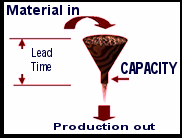 drilling, edge banding, finishing, assembly and so on. Measure the capacity of each work station and only plan to put that amount of work through each station it is capable of doing. Remember that each station either is, or has a dependency. So, in other words, assembly cannot start until CNC cutting is done. Assembly is therefore “Dependant” on CNC cutting so you cannot plan work to start in the assembly station until after the parts are cut. This planning is done by way of the “finish to start” method. Find your longest lead time process and back schedule it from your finish date. If you are after today’s date your work is usually achievable... assuming your materials are available to do the work.
2) Material requirements plan (MRP):Planning production in workstations is one thing, but it must be partnered with the materials being available to do the work. The lead times of materials being delivered are critical when planning production as well as stock levels. There are many MRP software packages on the market; however “CMO Office Suites” will help you track all orders for each specific job and track them through to completion. Your accounting software should do the rest for you.
3)Technology, you and you machinery:
In today’s cabinet manufacturing plant, waste, throughput, errors and efficiencies are all “top of the list” topics. Many of the design software on the market today will allow information to flow right out of the job design to the cut-lists or link to a CNC or beam saw to start producing parts (screen to machine). The most effective by far is “nesting’ CNC technology. Some of the advantages of nesting are the sorting of parts and allocation of a part to a specific part of a cabinet. Rarely are parts made to stock. The most important measure of throughput is not how fast an individual machine can cut parts, but rather how quickly can a finished project be completed and payment collected for that product. Beams saws may cut many parts faster, but they only do one task and usually do not keep up with a nesting machine when measured against how fast a kitchen can be produced using nesting CNC.
4) Labels and “upstream” production:
Some cabinet shops produce parts very quickly using "make to stock" theories. The time needed to then track stock levels, pull stock for specific jobs and accounting for spoilage and damage makes this method quite inefficient compared to a “make to order” method. This is especially true when employing CNC nesting machines. When a CNC machine cuts a part, that part will then be labeled so that when it travels “downstream” there will never be a need to wonder “what is this part for”, take the time to put a tape measure on it, check on a list for that size part etc. The label will tell you everything you need to know in seconds. It is also recommended that all parts for a specific job be grouped into a cart vertically so that these parts will move through the plant from workstation to workstation as a completed project greatly reducing the chance of error, damage and missing parts.
........... 5) BPM (Business Process Management):
Many companies have managed to dramatically increase their throughput in the plant by implementing many of the topics outlined in this article. This will in turn put much more demand on the office systems to keep up with this increased level of business. Adding more staff defeats the goal of increasing profits so there needs to be a level of automation implemented in the office systems. This automation usually comes in the form of a BPM system such as CMO Office Suite that will manage and monitor all areas of the company.
Collaboratively sharing information is the foundation for this success. Making sure you balance the supply and the demand is the only way you will get the absolute maximum out of your operation. The relationship between the 3 key areas of sales, finance and manufacturing must be kept in balance.
........... 6) Your staff and THEIR needs:
Believe it or not, your staff is very easy to make happy and keep productive. They want to know what you want them to do and when you want them to do it. They also want to ensure they are rewarded for their achievements. Not everyone, however, is suited for all tasks so you must make sure the skills of each person are matched to their tasks. This job is made much easier with the creation of shop “standards” that everyone follows. Creating repeatable tasks that can easily be taught to a new staff member is a good way to ensure company standards are met. There should not be too many workers that retain information the company is dependent on. Information out of the office to the shop floor must be accurate and legible.
7) Outsource, outsource, outsource!
Most shops have a list of production areas they do very well with and some they are not really set up to do efficiently. A good example of this is door making. Many cabinet plants outsource their doors from specialist companies because they will offer a better quality door with many more options than if the doors were made in-house. Look closely at what you do well and don’t be afraid to look outside for help.
8) Light a fire under them!
Creating a production plan based on capacity means measuring how fast each employee performs his or her tasks. Be careful not to try implementing “industry standards” as they may not relate to your specific environment. Measure the average rate a worker produces and make them aware that “all is good” if they continue this pace. If they exceed this mark, they will qualify for a bonus. One of the greatest features of CMO Office Suites is the touch screen interface each employee can use. This gives the company direct feedback on each employee and automatically creates the ability to measure performance bonuses that each worker will be happy to strive for because it is offered in a fair and achievable way.9) The good old K.I.S.S theory:
Trades people think differently than the majority of their clients. Many cabinet shop owners were trades people in their past lives and still run the company thinking like a tradesman. This will usually cost the company money and produce little benefit. A good example of this is how cabinets are constructed. Most cabinet makers, by nature, want to create complex joints because they will gain personal satisfaction from their ability to create this joinery. Most times however, when their clients are asked after the job was completed what was important to them or why they bought from the chosen shop, they respond with answers such as service, design choices, finish and quality etc. They really didn’t care if the cabinets were constructed with dado's, rabbets or dowel joints.
This is not to say that you can slap a cabinet together any old way and call it good. The point is to operate your company as a business owner, not as a trade person, and make sure you are meeting the standards required by your clients while not exceeding them to the point of excess. Ask questions of your clients and for those requiring a much more complex construction method you can still provide this level of product - but then charge accordingly for it!
10) Bonus Suggestion:
Ensure that all staff in key positions are dedicated to their specific job and are not wearing too many hats. As an example, many business owners think they are running the business by doing it all themselves - sales, shop management, material ordering, etc. In this case they are not running the company, the company is actually running them - and not doing so very efficiently either!
The owner needs to be working on the company not in it. Similarly, a key staff member such as a technician That tis responsible for feeding information to your CNC machine from design software and is the software specialist should be dedicated to that task only.
This is a common position that is not filled correctly. The person in this role is one of the most important people in the company because they are responsible for the product and all details regarding it. If the work is not correct at this point, the mistakes will flow through the company like the plague!
Have this person only responsible for making sure all jobs are machined correctly and all software to maximum efficiency for the company and this will have a MASSIVE impact on all other areas of the company.